Get Better Sleep With Ultrasound Patch That Boosts REM Rest
A wearable bioelectronic device increased REM sleep in real-world trials, without invasive surgery or medication.
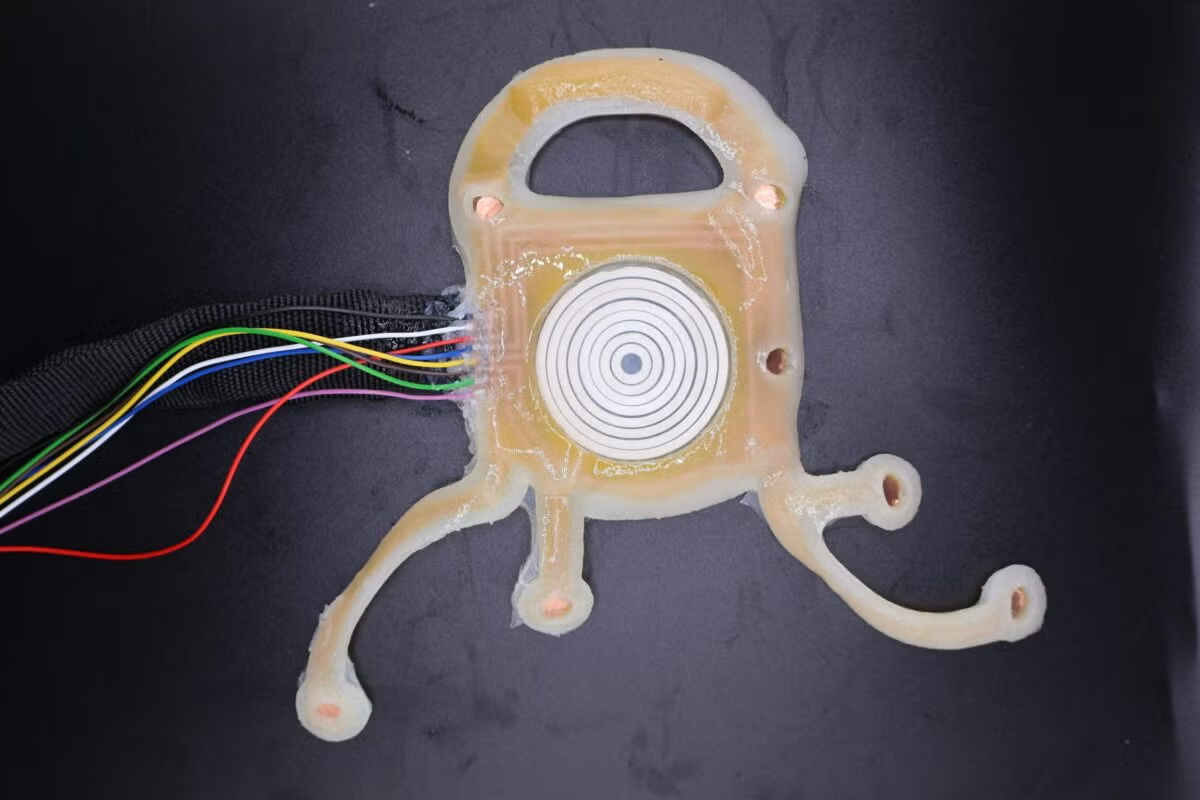
Credit: Huiliang “Evan” Wang
In a sleep management breakthrough, a University of Texas at Austin-led team of researchers has developed a noninvasive patch that boosts REM sleep in real-world trials without surgery or medication. The technology, called NEUSLeeP, is a soft, wearable device that uses gentle ultrasound waves and electrodes to stimulate deep brain regions and monitor brain activity in real time.
“This is the first time we’ve been able to noninvasively target deep brain regions involved in REM sleep, while simultaneously monitoring brain activity,” said Kai Wing “Kevin” Tang, a recent UT biomedical engineering Ph.D. graduate who led the research effort. “Our skin-attached NEUSLeeP patch opens up new possibilities for understanding sleep and treating sleep disorders in home settings,” added Huiliang “Evan” Wang, assistant professor in the Cockrell School of Engineering’s Department of Biomedical Engineering, who supervised Tang’s work and served as the principal investigator (PI) directing the overall project.
In a study of 28 people, published in Nature Communications, the patch helped participants reach REM sleep 43 minutes faster and stay in it about 16 minutes longer on average. The effect held for both healthy sleepers and people with some sleep issues. The participants also said the patch was comfortable and safe, with minimal adverse effects.
The study also found that NEUSLeeP’s stimulation improved heart rate variability — a marker of healthy stress response — in healthy participants. Brain scans showed changes in emotional brain circuits, suggesting potential benefits for mood and resilience.
“REM sleep is not just about dreaming — it’s about emotional reset and stress adaptation,” explained Gregory Fonzo, assistant professor in the Dell Medical School’s Department of Psychiatry and Behavioral Sciences and one of the project’s co-PIs. “By enhancing REM, we may help people better cope with stress and improve their overall well-being.”
Disrupted REM sleep is linked to conditions such as depression, anxiety and post-traumatic stress disorder (PTSD). Yet, most treatments for sleep problems, such as medications or behavioral therapy, can have side effects or fail to address the underlying issues influencing REM sleep.
The researchers are planning larger trials to confirm their findings and explore NEUSLeeP’s potential for conditions such as PTSD, depression and chronic insomnia. They also envision the patch being used for at-home sleep monitoring, brain research and even personalized sleep therapies.
“Our vision is a future where patients with mental health disorders can optimize their sleep with a noninvasive and safe treatment,” said Vincent Mysliwiec, M.D., a professor at UT Health San Antonio, a leading expert in sleep disorders, and another co-PI on the project. “This technology could help millions of people get the restorative sleep they need.”
The researchers are working with UT’s commercialization unit, Discovery to Impact, to bring the product to market. They’ve filed a patent application for the technology.
Other team members are William D. Moscoso-Barrera, Mengxia Yu, Mengmeng Yao, Jinmo Jeong, Ilya Pyatnitskiy, Anakaren Romero Lozano, Jiachen Wang, Ju-Chun Hsieh, Tony Sungjin Chae, Daniel Song, Julieta Garcia, Rithvik Mittapalli and Adam Bush of the Department of Biomedical Engineering; Benjamin Baird of the College of Natural Sciences’ Department of Psychology; and Wynn Legon of Virginia Tech’s Fralin Biomedical Research Institute.